

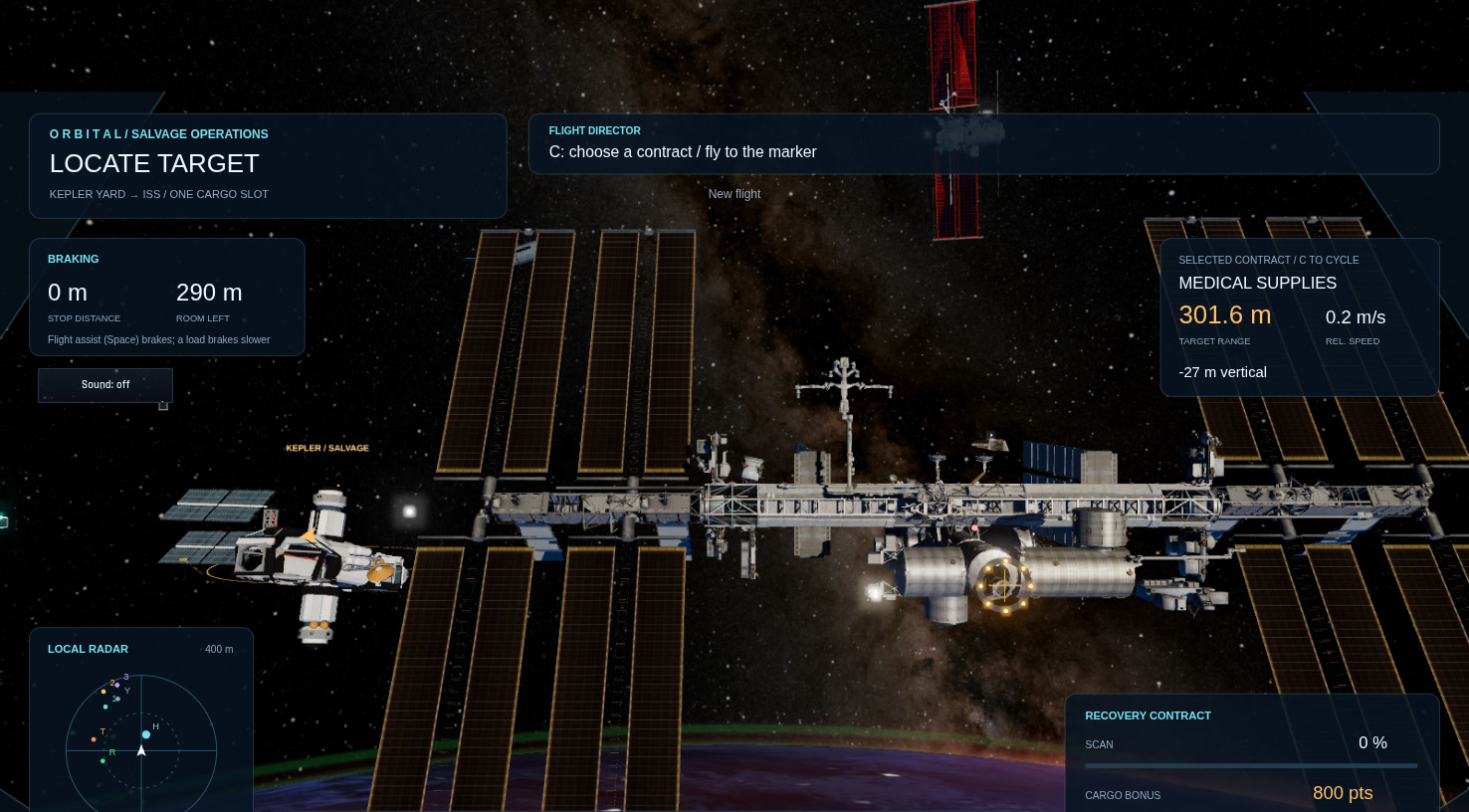
A dashboard you can fly
Recover drifting cargo from a salvage yard and bring it home to the station, or rescue a disabled tug before it hits. Heavier cargo cuts your thrust and braking, so you have to start slowing down earlier. Docking demands under 0.4 m/s, within 1 m of the port's axis, pointed at it and level.
What runs underneath
The ship is one MACS Studio model, built from library blocks on ten sheets. It covers six degrees of freedom in the station's frame, RCS translation, fly-by-wire attitude, propellant, collisions and a boost engine with heat management. Clohessy–Wiltshire drift at the ISS's orbital rate bends every coast, so a ship left alone drifts away.
Why it's here
Every instrument, camera view and sound in the browser is driven by signals from the model. The same approach works for an HMI on a test bench or a training simulator for real equipment.
This is a simulation, built to show what MACS can do.
Assets: "International Space Station" by BlendRuN (CC BY 4.0, modified). "Wikiplanet Space Station (WSS)" by Alan Zimmerman (CC BY 3.0). "Hubble telescope" by Poly by Google (CC BY 3.0). Ultimate Spaceships Pack by Quaternius (CC0). Gateway Core, NASA/JSC. Blue Marble and Black Marble Earth imagery, NASA Earth Observatory. Deep Star Maps 2020, NASA/Goddard Space Flight Center Scientific Visualization Studio, with Gaia DR2 data from ESA/Gaia/DPAC. NASA does not endorse this project.