

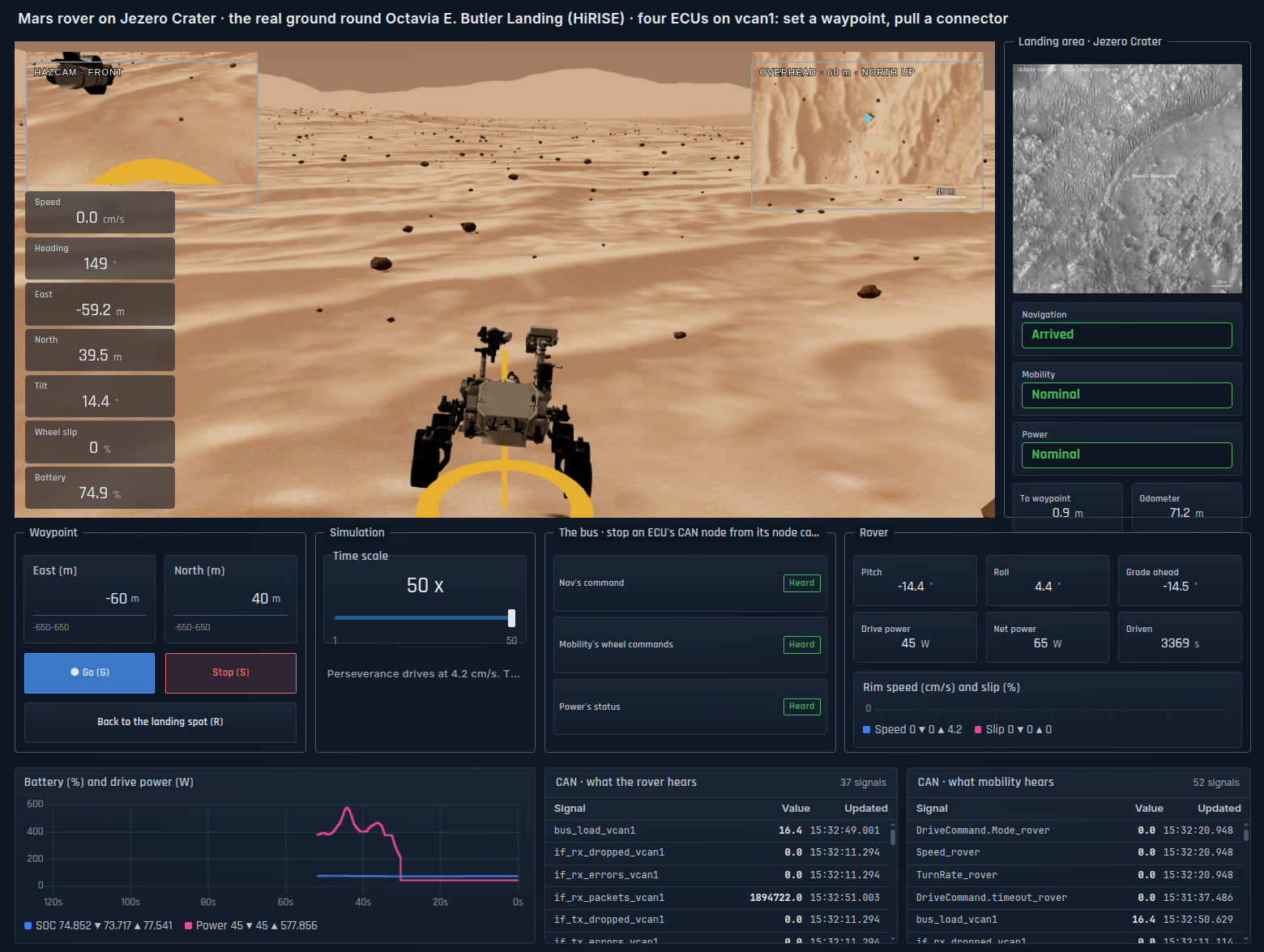
Four computers, as on a real rover
The nodes talk to each other only over a virtual CAN bus, wired from rover.dbc.
| Node | What it does |
|---|---|
| Rover | Six driven wheels, front and rear steering, slip on grades, the power bus and its sensors |
| Mobility | Turns the drive command into six wheel speeds and four steering angles, with tilt and stuck safing |
| Nav | Drives to a waypoint: turns in place to face it, follows an arc, and slows for the last metres |
| Power | Runs the 110 W RTG and 2.4 kWh battery, and sets what the drive may draw |
When a node goes silent
| Lost | What happens |
|---|---|
| Nav | Without a drive command, Mobility stops the wheels until Nav returns, and Nav carries on to its waypoint |
| Mobility | Without wheel commands the rover stops, and Nav reports no bus |
| Power | Mobility halves the speed, because it no longer knows what the battery allows |
The real ground
The rover starts from Octavia E. Butler Landing, where Perseverance touched down in February 2021. The view layers public orbital data at three scales: the 60 km crater, the 1.4 km landing site and the first 600 m in 25 cm imagery. The physics and the 3D view stand on the same height data, so the rover slips and tilts on the ground you see.
The rover's geometry is about Perseverance's. Its suspension and slip are a model, not the real mechanism.
This is a simulation running on a virtual CAN bus, built to show what MACS can do.
Data: HiRISE terrain and images, NASA/JPL/University of Arizona. CTX mosaics, NASA/JPL/MSSS and the USGS Astrogeology Science Center (Fergason et al., 2020). Perseverance model, NASA/JPL-Caltech. Gravel texture, ambientCG (CC0). NASA does not endorse this project.